
Article originally published 8 September 2026 by the NBR and updated on 14 September 2026.
Two years ago, in September 2024, financial markets were fixated on a rapidly developing AI boom. The leading US hyperscalers were jumping over each other to announce the investment of billions of dollars in cloud capacity. Nvidia’s share price had risen 10-fold in the prior 2 years on the back of phenomenal earnings growth. Meanwhile, the bond market was looking rather unremarkable, as it often does, with core inflation having dropped below 3%, the Federal Reserve commencing a rate cut cycle and the US 30-year bond yield trading just above 4%.
Long-term bond yields at multi-year highs
Roll forward to today and financial markets have brought the bond market to the front of the conversation. The US 30-year bond yield is now around 5.25%, which is the highest yield since 2007. The same phenomenon is at play in other major bond markets, with German and Japanese 30-year yields also at multi-decade highs.
Investors are busy taking apart the old narrative and reconstructing the new evidence. Given the interconnected nature of financial markets, economies, politics and societies, there is scope to find a plethora of things to worry about. Some of these aspects will be considered below, with a focus on implications in New Zealand.
Why are yields rising? A combination of simultaneous developments
Going back to AI, the hyperscalers’ (Microsoft, Amazon, Alphabet and Meta) investment in data centre capacity is one of the causes for higher bond yields. Collectively they are expected to borrow US$850bn this year and follow that up with over US$1000bn in each of the next 2 years. This quantity of issuance puts upward pressure on bond yields. Data centre demand for electricity has contributed to pushing US electricity prices over 30% higher in the last five years, adding to an inflation problem for the US Federal Reserve. AI is not just a technology change; it is likely to be impactful in terms of economic growth. The idea that investment booms affect bond markets also reconciles with economic theory. In a boom, the phase where investment is rolled out puts demand on resources and may increase inflationary pressures for a considerable period before the benefits of the investment arrive.
Acknowledgement of the timing differences can and should be factored into monetary policy decisions by central banks that aim to manage the volatility of inflation. It is appropriate that the US Federal Reserve is tilting towards rate hikes, whereas 12 months ago cuts were more widely anticipated. Higher inflation and tighter monetary policy can add to pressure for bond yields to rise except when tighter policy is aggressive enough to slow activity. Economic growth in the US is still robust, indicating US monetary policy isn’t particularly restrictive.
Core inflation in the United States is running at 3.3% and has been above their target rate of 2% since June 2020, when Covid-19 lockdowns first stalled activity sharply. The US Federal Reserve, as with plenty of other central banks, faces a challenge of credibility that has not yet been adequately addressed by the new Governor, Kevin Warsh. This is another aspect that is arguably having a bearing on bond yields.
However, the elephant in the room (by no means the least appropriate metaphor) is the US government’s fiscal position. Since Covid-19 the US government has run much larger government deficits. Originally this was to support the economy, but that crisis has passed. A deterioration this year has taken the deficit to around 6% of GDP. This rise in the deficit has reflected three factors: the Supreme Court deemed some tariffs to be unlawful, tax cuts that were due to expire have been extended and the Iran conflict has prompted an increase in military spending.
Not only is the deficit large, but the amount of outstanding debt has increased to a high level. The US Federal debt is at 99% of GDP and the cost of servicing that now takes up 18.5% of all tax revenue. By comparison, New Zealand’s net core crown debt/GDP is at 42% and the cost of servicing that is 6.6% of all government revenue. If we had similar debt metrics in New Zealand, the government would have to find $16bn extra to pay the interest on debt. Unfortunately, there are other countries that face challenges similar to the US. Japan, France and the United Kingdom are the most notable examples. These countries make up a large part of the global bond market.
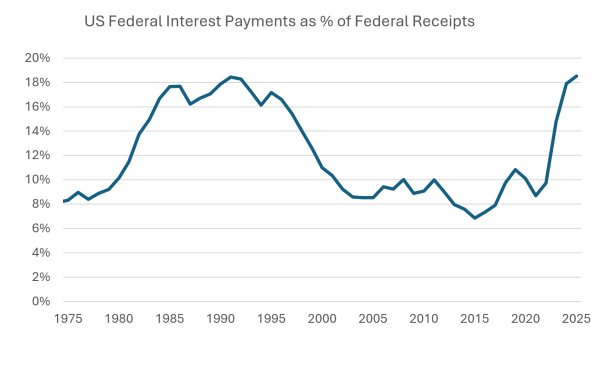
Source: US Office of Management and Budget via FRED
The challenge the US government now finds itself in is that investors are becoming more concerned about the sustainability of the debt position. To a degree, this has undermined the US Dollar’s status as the global reserve currency. While there is no credible currency alternative, some investors have shifted savings to the gold and crypto markets. To make matters worse, the US Government is not showing any active policy initiatives to address the deficit. The main initiative taken has been to skew the issuance of new debt funding away from long maturity bonds, in an attempt to reduce upward pressure on long-dated bond yields. So far this has been partially successful, in that the rise in 30-year bond yields has been orderly.
In Europe, fiscal positions are also a challenge in some countries. France has found it very difficult politically to address deficits. The UK bond market has been whipped around by inconsistent policy announcements.
So, we have a global bond market where the combination of growing debt levels, AI-related infrastructure investments, higher oil prices and questions over the commitment of central banks to deliver price stability have been pushing long-term bond yields higher. What next?
What challenges arise from higher bond yields?
The most obvious issue here is debt servicing. The ability to earn one’s way out of increasing debt becomes harder. Many governments around the world have experienced this issue over the last 100 years. Actual debt defaults have mainly happened when countries do not borrow in their own currency, which can happen when the domestic financial market is not deep enough. In this regard, the United States is very unlikely to face the risk of default in the near or medium term.
Higher bond yields, particularly in the United States, are also likely to ripple through into other parts of the financial market. It typically has a negative effect on risk asset classes, particularly listed equities, when a move in bond yields is large enough. Bonds become a more attractive investment and as long-term bond yields are typically used to provide the discount rate to value a firm’s future cash flows, equity valuations would have a bias to reprice at a lower level, all else equal. At present, all else is not especially equal in the tech sector, and more broadly across the equity market every sector has seen positive earnings revisions: strength in corporate earnings have offset the valuation impact of higher bond yields.
But eventually higher bond yields will impact the consumer and most likely the housing and construction sectors.
Specifically, what impact might be felt in New Zealand?
In New Zealand short-term interest rates are driven by domestic fundamentals but long-term yields are also influenced by global dynamics. Therefore, a degree of spillover re-pricing effects on domestic longer-dated yields is to be expected. New Zealand long-term yields have risen recently, although the magnitude of the move has been less than other global markets. There have been two aspects at play. Firstly, the domestic economy is only making slow progress erasing spare capacity, hence the pressure on the Reserve Bank to hike interest rates is less than, say, the US. Secondly, relatively well anchored short-term rates help longer-term bond yields avoid volatility.
As described earlier, New Zealand’s current fiscal position is considerably better than in the US and better than most other advanced economies that our market gets compared to. Australia is also in a good position, so our proximity and connections are also beneficial. These factors are very helpful for the New Zealand bond market, but there is a caveat here. When investors are attuned to a specific risk, you really don’t want to be a problem child. It will be very important for our government (before and after the election) to retain a credible fiscal policy in the eyes of global investors.
Also, after decades of excess borrowing by the private sector, our banking system is reliant on funding from overseas. Large disturbances to foreign bond markets may lift the cost of this funding regardless of how New Zealand’s government financial position is viewed.
What about rising short-term rates?
Last week, New Zealand swap rates rose sharply, in response to a spike in oil prices above US100 per barrel. While this move is not associated with fiscal deficits, we are all also very aware of rising prices at the fuel pump. With events in the Arab Gulf deteriorating, the domestic market can see that inflation here may not decline as rapidly as the Reserve Bank projects and is concerned that the guidance that they have given about modest and gradual rate hikes may be forced to be more aggressive. This caused some capitulation from (largely offshore) investors, who had invested on the basis of the more benign outlook.
Higher petrol prices and higher swap rates (via mortgage rates) is clearly a further constraint for households and at the margin makes an economic recovery here more difficult to achieve. The Reserve Bank, which is being asked to look through more and more petrol price hikes, may well assess that it cannot afford to continue with a patient approach.
With upward pressure being felt via fiscal deficits, it is not an easy time to add rising oil prices to the mix. It is still difficult to know how long it may take for the Straits of Hormuz to reopen and for infrastructure to be repaired. It is starting to look as if this may take much longer than was assumed early in this conflict.
Roll forward five years to 2031. The tests for the sustainability of fiscal positions, particularly in the US, but also New Zealand, will be weighed by the bond market. How core inflation trends spill into economies and inflation expectations will also be critical. Bond markets typically shoot first when they lose confidence, and the risks at the moment seem asymmetric. In New Zealand the challenge will be to control the controllables. A credible fiscal policy will be an important issue for the domestic fixed interest market.
IMPORTANT NOTICE AND DISCLAIMER
This publication is provided for general information purposes only. The information provided is not intended to be financial advice. The information provided is given in good faith and has been prepared from sources believed to be accurate and complete as at the date of issue, but such information may be subject to change. Past performance is not indicative of future results and no representation is made regarding future performance of the Funds. No person guarantees the performance of any funds managed by Harbour Asset Management Limited.
Harbour Asset Management Limited (Harbour) is the issuer of the Harbour Investment Funds. Copies of the Product Disclosure Statements are available at https://www.harbourasset.co.nz/our-funds/investor-documents/ Harbour is also the issuer of Hunter Investment Funds (Hunter). A copy of the relevant Product Disclosure Statement is available at https://hunterinvestments.co.nz/resources/.
Please find our quarterly Fund updates, which contain returns and total fees during the previous year on those Harbour and Hunter websites. Harbour also manages wholesale unit trusts. To invest as a wholesale investor, investors must fit the criteria as set out in the Financial Markets Conduct Act 2013.