
Key market movements
-
Global equities were mixed in September, with the MSCI ACWI returning 3.6% in NZD-unhedged terms but declining -0.8% in NZD-hedged terms as the New Zealand dollar fell sharply over the month. Performance remained dominated by AI-related companies, although rising bond yields and higher oil prices created challenges for the broader market.
-
The New Zealand market was weaker over the month, with the S&P/NZX 50 Gross Index (including imputation credits) returning -0.4%. Australian equities also declined, with the S&P/ASX 200 Index down -2.4% in Australian dollar terms and -0.6% in New Zealand dollar terms.
-
Fixed income markets were challenged by a further rise in global bond yields. The Bloomberg NZ Bond Composite Index returned -1.0%, while the Bloomberg Global Aggregate Bond Index (hedged to NZD) fell -1.8%, as investors responded to persistent inflation concerns, higher energy prices and increasing government and corporate borrowing requirements.
Key developments
The defining feature of September was the continued rise in global bond yields. Higher oil prices, persistent inflation pressures and surprisingly resilient economic activity combined to push government bond yields to multi-year highs across most major markets. While higher yields created headwinds for bonds and many equity sectors, global economic activity remained firmer than expected, helping support corporate earnings and limiting the extent of equity market weakness. AI-related technology companies continued to attract capital as demand for chips, memory, cloud infrastructure and networking equipment remained exceptionally strong. However, market leadership narrowed further, with many sectors struggling to keep pace as investors increasingly focused on companies positioned to benefit directly from ongoing AI investment.
Oil prices pushed back above $100/barrel during September on renewed Middle East uncertainty. Talks between the US and Iran stalled during the month, and energy markets were further unsettled by reports that the US was considering restrictions on diesel exports. With Chinese refiners also restricting exports, along with key refining countries like Kuwait and Qatar suffering supply constraints, the focus of the energy crisis has increasingly shifted from crude to refined product. For central banks, the problem remains the same – higher energy prices are slowing the disinflation process for most economies and likely require tighter monetary policy.
Global interest rates remained under upward pressure across the curve, with central bank rate hikes pushing the short end higher. The US Federal Reserve lifted the Fed Funds rate by 25bp to 3.75-4.00%, as widely expected given elevated inflation, robust economic growth and a still-low unemployment rate. Fed Chair Kevin Warsh said "the plain fact is that inflation is too high and has been for too long," adding that "this summer's inflation readings do not tell me that underlying trends have meaningfully improved." These comments supported market pricing of a terminal effective Fed Funds rate of 4.7% in about one year's time. At longer bond maturities, several factors are at play, including strong growth expectations, higher term premia linked to fiscal sustainability concerns, and increased issuance from AI hyperscalers. Bond market moves have diverged somewhat as fiscal concerns in the United States, the UK and France attracted bond vigilante wrath.
The NZ economy expanded faster than expected in the second quarter, despite elevated interest rates and fuel prices. Growth of 0.2% for the quarter, 2.6% year-on-year, was led by goods-producing sectors and exports rather than household spending, and combined with positive revisions to prior quarters, the data suggests the economy may have weathered recent challenges better than many expected. Significant spare capacity remains, however, and monetary policy is providing little support: the RBNZ lifted the OCR by 25bp to 2.75% in early September and the market prices an aggressive tightening cycle to 4% by the end of next year. Mortgage rates are already above 5% for most fixed terms and above pre-Covid levels, while the unemployment rate is high at 5.6%, accompanied by slow wage growth and pockets of job insecurity. Likely reflecting this challenging and uncertain backdrop, household savings rates have picked up, and weakness in the housing market has added further downward pressure to consumption.
What to watch
Every query, response and AI-driven task is measured in tokens, each roughly three-quarters of a word. As AI shifts from answering questions to carrying out complex, multi-step tasks, token volumes rise sharply and the price per token matters a great deal for any business deploying AI at scale. Models fall broadly into two camps: closed models from providers such as OpenAI and Anthropic keep their parameters proprietary, while open-weight models publish them, so anyone can run or adapt the model at low or no cost. The split is increasingly geographic, with Chinese labs leading in open weights and US labs still ahead at the frontier.
On OpenRouter, a platform that developers use to access many providers, the share of usage going to open-weight models has risen from roughly one-third in April to about two-thirds in recent weeks, largely on the back of Chinese models (see chart). Price goes a long way to explaining the shift: US closed models cost around US$6.86 per million output tokens against US$1.31 for Chinese open-weight alternatives, a fivefold gap. Total token spending has stayed broadly flat even as usage has surged, which we think reflects a deliberate move to cheaper models rather than weak demand. US labs still lead on the hardest tasks, but if more growth flows to lower-cost open models, the returns from AI may be spread more widely than today's concentration in a handful of US companies implies.
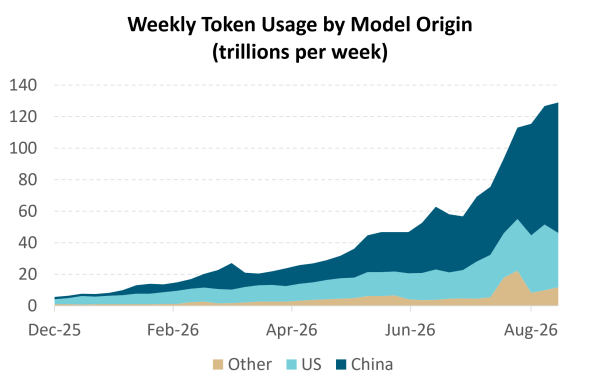
Source: OpenRouter (openrouter.ai/rankings), as of 27 September 2026. Usage is weighted towards developers and is not total market share.
Market outlook and positioning
Globally, the outlook remains balanced between strong earnings growth and ongoing pressure from higher bond yields. The AI investment cycle should continue to be an important source of economic activity and earnings growth, although the benefits are unlikely to be shared evenly across sectors. Companies supplying the infrastructure required for AI remain well positioned while investors are increasingly assessing which businesses can use the technology to improve productivity and create sustainable earnings growth. Higher starting bond yields have also improved long-term return prospects for fixed income, although inflation, government borrowing requirements and refinancing needs are likely to create a wider range of outcomes across markets and issuers.
The New Zealand outlook remains mixed but is improving gradually. Economic activity has proven more resilient than many expected, led by exports and primary industries, while company earnings have generally held up better than feared. However, higher interest rates, a soft housing market and cautious consumers continue to weigh on domestic demand. With local share market valuations broadly in line with long-run averages, future returns are likely to depend increasingly on earnings growth rather than valuation expansion. Encouragingly, earnings expectations have begun to stabilise, although investors are likely to remain selective until there is greater confidence that growth is becoming more broad-based.
Australia faces a more challenging backdrop. While consensus earnings growth expectations remain relatively healthy, expectations have been trending lower as weaker consumer spending, softer housing activity and the effects of restrictive monetary policy become more evident. Company management teams are likely to remain cautious, with margin management and cost control continuing to play an important role in supporting profits. We expect greater divergence in earnings outcomes across the market, creating opportunities for selective stock picking, although broad market returns may remain more sensitive to interest rates and economic growth concerns than has been the case globally.
For the equity growth funds, our approach remains to be patient, position for a range of scenarios and to be selective, focusing on growth. We continue to focus on companies delivering earnings per share growth, particularly where that earnings growth has the potential to be higher and last for longer than consensus expectations allow for. We continue to see the secular tailwinds of digitisation, de-carbonisation, deglobalisation, and demographic changes as supporting company earnings. In that context, the portfolio retains an overweight position in healthcare, where we see attractive opportunities across New Zealand retirement villages and Australian pharmaceutical and diagnostic businesses with long-duration growth characteristics. We also remain overweight financials, reflecting exposure to companies such as Infratil, AMP and Macquarie that may benefit from data centre investment, alternative energy development and improved transaction activity. Within consumer staples, we continue to see upside in businesses such as a2 Milk and Scales, where company-specific drivers may support earnings growth. Offsetting these positions, the portfolio remains underweight utilities, communication services and real estate. In each case, we see a less compelling balance between valuations and earnings prospects, with gentailers facing higher earnings uncertainty, telecommunications operating in a competitive environment, and property companies generally offering more modest growth outlooks.
In fixed interest, we are becoming more comfortable with investing, after the sharp rise in yields that we have experienced over the year. We like short-dated (1 to 3 year) bonds, as these provide yields that anticipate the Reserve Bank hiking the Official Cash Rate towards 4%. That level is only compatible with more negative scenarios that envisage continuing elevated inflation. Meanwhile, we see longer-dated bonds as being susceptible to higher volatility, both up and down in yield, with the drivers of higher yields being problems that have not been resolved. Fiscal concerns remain in some global markets. However the absolute level of yields is now arguably reflecting identified risks. We are becoming more willing to invest, albeit with some ongoing caution. Corporate bond spreads in New Zealand have held into fairly tight spread levels despite widening in spreads in global markets, particularly in the lower end of the credit rating spectrum. We see a skew of risks that NZ corporate bond spreads cheapen a little and as a consequence we are adopting a moderately cautious approach at present.
In multi-asset funds, we are modestly underweight growth assets. This is composed of an overweight to global equities that is more than offset by an underweight to Australasian equities. We feel global equities should outperform Australasian equities given better earnings and economic momentum but are conscious of the headwinds to growth assets from elevated interest rates, high oil prices and growing AI safety concerns. We remain overweight global fixed income, the position funded via an underweight to domestic fixed income. We prefer global bonds to domestic due to their generally higher yield and longer duration, allowing them to likely provide better portfolio protection in the case of a negative demand shock. We continue to have higher levels of NZD hedging relative to benchmark given NZD/USD is significantly below our short-term estimate of fair value.
In the Income Fund, we have replicated fixed interest strategy into the portfolio, which reflects a positive view about shorter dated bonds. We have also been increasing global equity exposure, as we judge that the challenges that arise from higher bond yields are reasonably well reflected in some more defensive parts of the market. Meanwhile in the AI and tech sector, with scope for a positive earnings season in the near-term calendar, there is room for the medium-term uptrend in prices to pick up again.
IMPORTANT NOTICE AND DISCLAIMER
This publication is provided for general information purposes only. The information provided is not intended to be financial advice. The information provided is given in good faith and has been prepared from sources believed to be accurate and complete as at the date of issue, but such information may be subject to change. Past performance is not indicative of future results and no representation is made regarding future performance of the Funds. No person guarantees the performance of any funds managed by Harbour Asset Management Limited.
Harbour Asset Management Limited (Harbour) is the issuer of the Harbour Investment Funds. Copies of the Product Disclosure Statements are available at https://www.harbourasset.co.nz/our-funds/investor-documents/ Harbour is also the issuer of Hunter Investment Funds (Hunter). A copy of the relevant Product Disclosure Statement is available at https://hunterinvestments.co.nz/resources/.
Please find our quarterly Fund updates, which contain returns and total fees during the previous year on those Harbour and Hunter websites. Harbour also manages wholesale unit trusts. To invest as a wholesale investor, investors must fit the criteria as set out in the Financial Markets Conduct Act 2013.