
The trouble with investing is that you don’t know what is going to happen next. That applies over the next week, the next month and the next year. On that logic, looking out over 20 years, which is an appropriate timeframe for most investors, would seem an unfathomable and daunting prospect.
So, what can we do? Referring to history is a great starting point. We can observe at a narrow level, bouts of large market falls and volatility. At a broader level, there has been huge technological change and over the last 50 years, less conflict across most of the world. This has led to a vast improvement in people’s standard of living. Perhaps our investment strategy can anticipate this continuing and recognise that those bouts of market volatility have habitually been followed by recovery. After all, the US S&P500 has recently traded at record highs. Bravo to the optimists!
But to repeat - the trouble with investing is that you don’t know what is going to happen next. Beyond the issue of investing in markets that are implicitly volatile, we will all frame our perspectives in the context of our own situation and also in terms of our own appetite for risk. This thought process may be sharpened if you’re close to retirement or already retired.
Inflation risks – now and into the future
At present, the reality of day-to-day cost of living increases is a very significant challenge for many households and not just in New Zealand. When prices rise it not only affects your cash flows now, but if inflation remains elevated, it can quietly undermine the real value of your savings over time. Inflation, its implications for investing and the potential role of inflation-indexed bonds is the focus of the rest of this article. It is particularly relevant for those of us contemplating the next 20 years of investing, through our retirement years.
The supply shock from the Arab Gulf has brought inflationary pressure back to front of mind. While the headlines focus on oil prices, there is also an underappreciated spillover into multiple petro-chemical products, including fertilisers. In coming months, the breadth of inflation is likely to rise. This is why the Reserve Bank of New Zealand clearly signalled last month that there are rate hikes to come. This is despite the pressure that households, firms and the economy more broadly is now facing, partly, but not entirely due to the Arab Gulf conflict.
There are other factors at play in the inflation outlook. Domestically, local authorities are raising rates well above the Reserve Bank’s 1% to 3% target band and seem likely to do so in the years to come, unless rates caps are introduced. Globally, broader themes which may increase inflation are at play. These include climate change, the demand for electricity required by data centres, an increasing proportion of the population in developed countries that have hit retirement and leave the workforce.
The impact of inflation on investments
Importantly for investors, rising or high inflation brings pressure on both fixed income and equity markets, often simultaneously. Higher inflation drives inflation-fighting central banks to hike interest rates. At a security valuation level, higher interest rates reduce the present value of future cash flows and that reduction will be reflected in lower prices for both fixed interest and equity securities. That’s a technical way of saying your traditional balanced portfolio may go down in value.
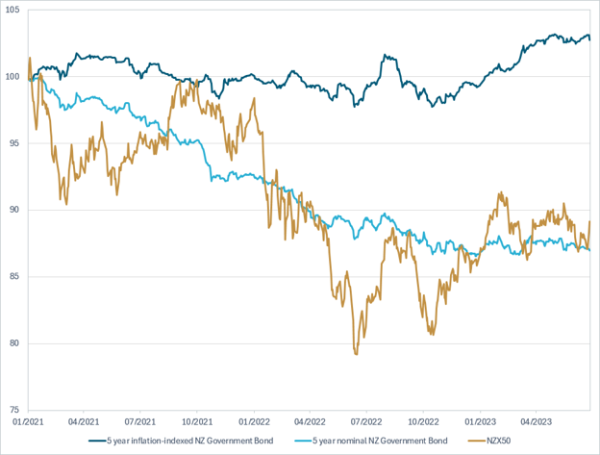
The inflationary episode post-pandemic between the start of January 2021 and the end of June 2023 provides an excellent example. The combination of ultra-low interest rates alongside substantial fiscal support drove inflation in New Zealand to a peak of 7.3% in mid 2022. Markets are forward-looking and had started to anticipate rapid increases to the OCR during 2021, with the first RBNZ hike occurring in October 2021. The experience of higher inflation and expectation of tightening financial conditions saw material losses across risk assets over the 2 ½ year period. New Zealand equity markets declined –10.9% and the nominal 5-year government bond price fell 13%. This positive correlation observed between bond and equity returns was a worst-case scenario for a traditional balanced portfolio where a 60/40 portfolio would have seen capital losses of –11.7%.
Cumulative price changes through Covid-induced inflation spike
Source: Bloomberg / Harbour Asset Management
Also shown on the chart, is the performance of a 5-year NZ Government Stock inflation-indexed bond. Inflation-indexed bonds are fixed interest securities that are designed to help preserve purchasing power when inflation rises. You can see the stability in the price over this period, with the inflation-indexed bond outperforming the regular, fixed rate 5-year Government Stock Index by nearly 16% over 2 ½ years. That is a big difference. Through this time, inclusion of inflation-indexed bonds helped immensely at a portfolio level by reducing the extent of negative returns.
So how do inflation-indexed bonds actually work?
They are able to explicitly isolate exposure to inflation movements because both the capital value and the coupon payments are indexed to New Zealand CPI. If inflation rises, both the capital value and the income stream derived from the bonds increases by the CPI change. Mathematically, and in simplistic terms, if inflation is 3.5% for 10 consecutive years, the price of a 10-year inflation-indexed bond rises from $1.00 to $1.41 at its maturity date, effectively matching the rise in the cost of living. Investors can therefore protect the real purchasing power of both their capital and income in an inflationary environment.
Inflation-indexed bonds as a part of your investment portfolio
Now that we have had a look at how inflation-indexed bonds work in isolation, we can now think about how they fit into a portfolio. An investor’s assets might include the family home, other property, a term deposit, shares and bonds. Investment typically works best when there is some diversification of asset classes, i.e. a portfolio is constructed. Indeed, conventional finance theory (for what it is worth) considers a security in terms of its contribution to a portfolio’s expected risk and return.
In this regard, inflation-indexed bonds can be thought of as helping to reduce the risk (or volatility) of portfolio returns. While episodes of higher inflation have occurred infrequently over the last 45 years since the 1970’s oil shock, it is during those periods that inflation-indexed bonds can be most useful. Phases of weak portfolio performance are when the human tendency towards risk-aversion most exposes us to here-and-now decision-making.
Finding a way to cope with volatility is a crucial aspect of investing. Despite the “Bravo to the optimist” comment we made early in this article, for many people, having a lower risk portfolio reflects their comfort zone. It is a very human reaction to uncertainty.
Global practice
In some offshore markets, inflation-indexed bonds are regularly used and the market is large. These bonds are typically seen as fitting in with other assets that may provide an inflation hedge, albeit an imperfect one, in various circumstances. Those other assets include gold, commodities, land and other “real” assets. The US Treasury Inflation Indexed Bonds Market cap is USD 1.47 trillion. The New Zealand market has NZD 26 billion market capitalisation. These bonds are used both within fixed interest portfolios, which is the most frequent practice in New Zealand, or as a separate asset class. The New Zealand market has steadily matured. The bonds don’t trade on the NZX Debt Market (NZDX) so access to them is generally available via brokers or within fixed interest managed funds, although the weighting is generally small. They are however an interesting and at times, very useful security to hold within a portfolio or diversified managed fund.
We now live in an environment with scope for ongoing inflation shocks, which can define the pattern of the current economic and market cycle. Numerous factors such as geopolitical instability, deglobalisation, supply chain restructuring, climate and energy security transition and an aging population have the potential to make it more likely we see frequent breakouts to the upside of the RBNZ 1-3% inflation target range this cycle. There is the potential for the increased productivity resulting from AI to have a disinflationary impulse which could provide some offset. However, if the skew of risks to inflation are indeed to the upside, a portfolio that includes an allocation to inflation-indexed bonds is a prudent strategy. We expect awareness of and interest in these securities to grow in New Zealand.
IMPORTANT NOTICE AND DISCLAIMER
This publication is provided for general information purposes only. The information provided is not intended to be financial advice. The information provided is given in good faith and has been prepared from sources believed to be accurate and complete as at the date of issue, but such information may be subject to change. Past performance is not indicative of future results and no representation is made regarding future performance of the Funds. No person guarantees the performance of any funds managed by Harbour Asset Management Limited.
Harbour Asset Management Limited (Harbour) is the issuer of the Harbour Investment Funds. A copy of the Product Disclosure Statement is available at https://www.harbourasset.co.nz/our-funds/investor-documents/. Harbour is also the issuer of Hunter Investment Funds (Hunter). A copy of the relevant Product Disclosure Statement is available at https://hunterinvestments.co.nz/resources/. Please find our quarterly Fund updates, which contain returns and total fees during the previous year on those Harbour and Hunter websites. Harbour also manages wholesale unit trusts. To invest as a wholesale investor, investors must fit the criteria as set out in the Financial Markets Conduct Act 2013.