
Key market movements
It was a volatile month for global equities, with the semiconductor complex coming under pressure and a reversal that saw value outperforming growth. The MSCI ACWI Index returned -3.1% in NZD-unhedged terms, however a strengthening New Zealand dollar meant that NZD-hedged returns were more benign at -0.5%.
The New Zealand market held on to a small gain, with the S&P/NZX 50 Gross Index (including imputation credits) returning 0.6% over the month, helped by some positive profit updates and a global rotation back into the oversold healthcare sector. Australian equities fared better, with the S&P/ASX 200 Index up 2.3% in Australian dollar terms, although only 0.4% in New Zealand dollar terms as the New Zealand dollar appreciated against the Australian dollar.
Fixed income returns were broadly weak. The Bloomberg NZ Bond Composite Index returned -1.1%, while the Bloomberg Global Aggregate Bond Index (hedged to NZD) also fell 1.1%, as government bond yields across developed markets moved higher on the energy‑driven inflation impulse and a heavy sovereign issuance calendar.
Key developments
July brought a strong sense of déjà vu. The tentative ceasefire with Iran was declared effectively over mid‑month, removing a de‑escalation assumption that had been embedded in market pricing for much of the previous quarter. Renewed tanker attacks and reports of Iranian mining activity in the Strait of Hormuz amplified the move, European natural gas surged after an LNG carrier was struck, and shipping traffic through the Strait slumped as US strikes continued. Brent crude rose 45% to above US$100 per barrel before easing to around US$85 by month‑end, still roughly 20% above where it finished in June. The renewed inflation impulse makes life more difficult for central banks, and the "one-off" characterisation of this shock is now in question, which raises the risk that higher readings become embedded in household and firm inflation expectations.
Global equities spent the month working through a different problem. Semiconductors began the third quarter as a potential place for traders to take profit after a first half in which the Philadelphia Stock Exchange Semiconductor Index doubled, and what started as profit‑taking became a large positioning unwind. Korean shares bore the brunt, with the Kospi falling into technical bear market territory more than 20% below its June peak, including a 6.4% single‑session fall in which Samsung and SK Hynix each dropped more than 10% and Korean authorities intervened. After an incredible run in the first half, with investors flocking to the region, the unwind was more about crowding rather than demand falling away. TSMC delivered a strong second quarter, ASML lifted full‑year sales guidance 10% above consensus numbers, and hyperscalers reaffirmed their spending plans throughout. Underneath the headline weakness there were some positives, with financials rallying, value outperforming growth, US banks posting a record earnings season, and Apple reaching a record high late in the month as investors rewarded its choice to rent AI capacity rather than build it.
Central banks turned more hawkish even as headline inflation fell. US June CPI fell 0.4% month‑on‑month, the first outright decline since 2020, and core prices were flat against an expected 0.2% rise, but Federal Reserve officials pushed back firmly on any dovish reading. The Fed left its target range unchanged at 3.50 to 3.75% at the end of July in what was read as a hawkish hold, with three of twelve members dissenting. The European Central Bank also held, at a 2.25% deposit rate, with a more hawkish message than expected, and markets now price a 60% chance of two hikes before year end against just one at the end of June. The Fed has an arguably easier job in tightening, because higher inflation is arriving alongside ongoing expansion and a still‑healthy labour market, and every major US bank beat second quarter expectations. Australia moved the other way, with June quarter core inflation softer than expected and market pricing shifting towards the Reserve Bank of Australia (RBA) staying on hold for the rest of the year, a reminder that the same energy shock is landing on very different domestic starting points.
In New Zealand, the Reserve Bank yielded to inflation risks at its July Monetary Policy Review and lifted the Official Cash Rate to 2.50% from 2.25%, its first hike in more than three years, framing it as removing accommodation rather than moving to restrictive policy and putting no commitment on timing. Second quarter CPI, released after the meeting, rose 4.1% year‑on‑year, the fastest annual pace in more than two years. Fuel was the main driver, but inflation still printed at 2.9% excluding fuel, and core measures were little changed remaining inside the 1 to 3% target band. Against that, large amounts of spare capacity continue to work in the other direction. Unemployment sits at 5.6%, the Reserve Bank's Kiwi‑GDP Nowcast points to almost no growth in the second quarter, house prices have not moved in a year, and rent growth, 10% of the CPI, has slowed to almost nothing while business investment declines and the government holds to fiscal consolidation. Confidence has lifted, however, and the external sector remains a bright spot, with July business and consumer confidence at five- and six-month highs, a notable pickup in dairy, meat and timber export values, and visitor arrivals back to 90% of pre‑Covid levels.
What to watch
Another source of upward pressure for global yields, in addition to higher energy prices and a hawkish Fed, has been the increasing focus on debt issuance by the hyperscalers as they commit to higher and higher levels of capital expenditure. The average yield for Amazon, Google, Meta, Microsoft, and Oracle 10-year bonds sits more than 100bp above the US government equivalent, vs. less than 90bp in early July. The equity market has taken a similarly dim view of the higher capex guidance, despite upside earnings surprises and a consistent message that demand continues to outstrip the supply of AI infrastructure. At a sovereign level, risks also remain skewed to higher yields as term premia remain around average levels despite an unprecedented amount of debt issuance from many developed countries.
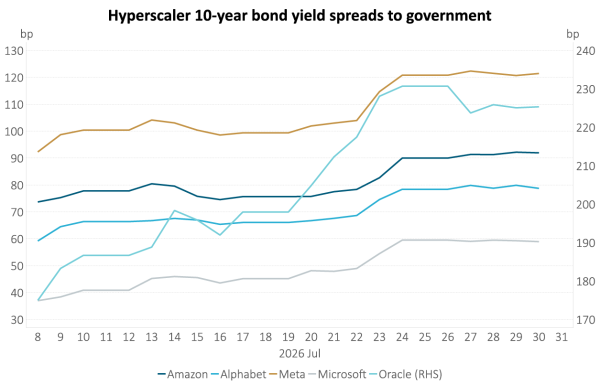
Source: Bloomberg, Macrobond, Harbour Asset Management.
Market outlook and positioning
The Middle East is once again the swing factor for markets. Higher oil prices are the main reason long‑term bond yields rose over July, and a further break higher in yields could unsettle share markets and drive a rotation of capital between asset classes. The reverse also holds. A genuine resolution would likely see yields fall back as quickly as they rose. We would be hard-pressed to forecast either outcome with confidence, which argues for portfolios that can tolerate both rather than portfolios positioned for one.
On AI, our take is that the unwinding of a highly leveraged trade is healthy and reduces systemic risk, even though it was uncomfortable to sit through. The debate about monetisation and returns on committed capital will continue, and positive indications from Microsoft and Amazon late in the month slowed the deleveraging without settling the argument. Harbour's research suggests the impact of AI on businesses and consumers has a long way to run, and carefully selected investment in AI bottleneck beneficiaries, including data centres, remains attractive. Infratil is a case in point: its share price fell over July on the pullback in AI sentiment, even as the independent valuation of Canberra Data Centre rose 23.6% during the June quarter.
The June period reporting season is the next real test. We enter the local season cautiously optimistic, expecting mid to high single‑digit earnings growth despite the macro uncertainty. The New Zealand share market is priced broadly in line with its long‑run earnings multiple, and consensus one year forward earnings expectations are modest, which sets a low hurdle. Our meetings with listed and unlisted New Zealand companies through July continued to point to "less bad" activity, with regions outside Auckland and Wellington notably stronger. Stabilising energy and wage costs support margins, and we continue to see upside for businesses executing self‑help strategies. Australia looks harder. Consensus expects more than 8% forward earnings growth, but earnings revisions have turned negative over both one and three months, led by energy, materials, utilities and information technology. That market trades above its long‑run multiple, and much of the premium sits in bank valuations at a time when RBA rate increases and asset quality questions are the focus.
Risks remain. A sustained energy shock is the obvious one, and embedded inflation expectations the more damaging, because that is what forces central banks to keep tightening past the point where growth can bear it. For global equities the bigger risk is execution, because a large share of index earnings growth now rests on a handful of companies converting enormous capital budgets into profit, and July showed how quickly sentiment turns when investors start to doubt that conversion. We do not dismiss that risk, but we are beginning to see genuine monetisation rather than promises of it, with cloud revenue growth accelerating at the large platforms and demand for AI infrastructure continuing to run ahead of supply. Corporate fundamentals more broadly have also held up better than feared, and New Zealand confidence is improving from a low base.
Within equity growth funds our strategy remains to be patient, to position for a range of scenarios and to be selective, focusing on quality growth. We continue to favour companies delivering earnings per share growth, particularly where that growth has the potential to be higher and to last longer than consensus allows for, and we continue to see the secular tailwinds of digitisation, de-carbonisation, deglobalisation and demographic change supporting company earnings. In the short-term, the funds favour businesses with idiosyncratic profit drivers, such as changing industry structures and self-help programmes. The funds are overweight healthcare, via New Zealand retirement village investments where returns may improve as supply and demand conditions stabilise and operational efficiency improves, and Australian pharmaceutical and diagnostics businesses with world-class products supporting long-term growth. They are also overweight select financials, where Infratil is positioned to benefit from data centre and alternative energy growth, Macquarie from stronger transaction activity and Challenger from improved capital efficiency, and consumer staples, where a2 Milk may deliver better returns as it re-establishes Chinese market share and Scales has upside in horticulture and proteins. The funds are underweight utilities, where gentailer valuation multiples remain full relative to increased earnings risk, real estate on modest earnings growth, and communication services where competition is elevated and multiples full.
In fixed interest, offshore volatility has left domestic yields near the upper end of their recent ranges. The New Zealand market now prices four further OCR hikes by mid‑2027, taking the terminal rate to just under 4%. We do not disagree with further near‑term tightening as the RBNZ moves policy from a stimulatory setting towards neutral, but the amount priced looks stretched against a recovery that remains narrow and uneven, and we hold a modest overweight duration position at the front end of the curve. Conversely, we hold a short duration position across longer-dated maturities, as we perceive an upside skew of risk to bond yields in the US, for reasons described above. We retain an overweight to inflation‑linked assets for their defensive characteristics, and a spread compression position between Australian and New Zealand ten‑year rates, where we expect further narrowing as the RBNZ tightens while markets increasingly price the RBA as having finished. In credit, the widening in hyperscaler spreads offshore has renewed investor focus, though broader indices remain near cycle tights, and we continue to favour high‑quality issuers and shorter‑dated maturities.
In the Income Fund, we have trimmed exposure to growth equities, following the recent lift in the domestic market. We are back into conservative mode. Active positions include being overweight the NZ dollar versus the Australian dollar and also retaining holdings in inflation-indexed bonds.
In multi-asset funds, we are overweight global equities and underweight Australasian equities in equal size on relative earnings prospects. We feel global equities should outperform Australasian equities given the US (which makes up almost 70% of the MSCI ACWI) has much better economic momentum. We remain underweight global fixed income where there is greater fundamental support for higher yields. We remain overweight the NZD as it continues to screen as undervalued based on our short-term model, however we continue to be active in trading the range that we have seen the currency sit in recently.
IMPORTANT NOTICE AND DISCLAIMER
This publication is provided for general information purposes only. The information provided is not intended to be financial advice. The information provided is given in good faith and has been prepared from sources believed to be accurate and complete as at the date of issue, but such information may be subject to change. Past performance is not indicative of future results and no representation is made regarding future performance of the Funds. No person guarantees the performance of any funds managed by Harbour Asset Management Limited.
Harbour Asset Management Limited (Harbour) is the issuer of the Harbour Investment Funds. A copy of the Product Disclosure Statement is available at https://www.harbourasset.co.nz/our-funds/investor-documents/ Harbour is also the issuer of Hunter Investment Funds (Hunter). A copy of the relevant Product Disclosure Statement is available at https://hunterinvestments.co.nz/resources/.
Please find our quarterly Fund updates, which contain returns and total fees during the previous year on those Harbour and Hunter websites. Harbour also manages wholesale unit trusts. To invest as a wholesale investor, investors must fit the criteria as set out in the Financial Markets Conduct Act 2013.