
Article originally published 11 August 2026 by the NBR.
The Asia-Pacific region is currently in an El Niño weather cycle. El Niño is one of the most important climate drivers for the New Zealand economy because it alters rainfall, temperature, wind patterns and agricultural output. Historically, there have been impacts on electricity hydro generation and lake levels, inflation, and on investment returns.
The risk of lower agricultural production, an impact on electricity prices, and a lift in inflation may increase the dispersion of investment returns. We may have entered the latest El Niño period in a better position with higher lake storage compared to previous El Niño cycles. It will depend on whether the cycle lasts longer than normal. El Niño is not all bad for investment markets – there are winners and losers – but risks need to be actively managed to optimise returns. Whilst we focus on the implications for New Zealand, the El Niño cycle will also likely have impacts on other southern economies including Australia, with crop and food production potentially the key area of risk, particularly for emerging markets and nations in Latin America, Africa and Asia which may compound the previous six months’ impacts of higher oil prices and constrained supply chains from the Iran conflict.
What is an El Niño weather cycle?
The El Niño–Southern Oscillation (ENSO) cycle, which occurs every 2–7 years, is a climate pattern caused by warmer-than-normal sea surface temperatures in the eastern Pacific Ocean. In New Zealand, it typically brings stronger south-westerly and westerly winds, drier conditions in the north and east of both islands, wetter conditions in western regions, and a higher risk of drought in key agricultural areas.
The developing 2026–27 El Niño is being forecast as a strong to potentially very strong event, with some forecasters suggesting it could rival or exceed the major El Niño events of 1982–83, 1997–98 and 2015–16. ENSO events typically last about 6–18 months, with most events persisting for around 9–12 months. The longest modern ENSO event affecting New Zealand was the rare “triple-dip” La Niña that persisted from mid-2020 to early 2023, lasting roughly three years.
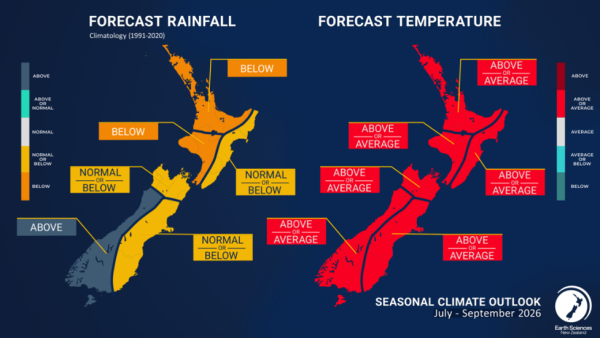
Historically, strong El Niño events favour drier-than-normal conditions in northern and eastern New Zealand, including Auckland, Waikato, Hawke's Bay, Canterbury and Otago, while the western South Island tends to be wetter. As shown in Figure 1, Earth Science New Zealand is currently forecasting a warmer and drier July to September 2026 for much of New Zealand.
Figure 1: Seasonal Climate Outlook July–September 2026
Source: Earth Sciences New Zealand, July 2026
The key uncertainty is that New Zealand rainfall is influenced by more than ENSO alone. Forecasters note that factors such as the Indian Ocean Dipole (IOD), Southern Annular Mode (SAM), regional sea temperatures and climate change can amplify or offset the classic El Niño pattern. However, the current outlook is for a stronger-than-normal El Niño signal, which suggests a higher risk of dryness in northern and eastern regions compared with many past ENSO events.
Strong El Niño events are typically associated with more frequent and stronger westerly and south-westerly winds over New Zealand, particularly through spring and summer. However, whether it is actually windier than previous strong El Niño cycles will depend on other climate drivers such as the SAM, the IOD, and regional sea-surface temperatures. New Zealand agencies note that ENSO explains less than 25% of year-to-year climate variability, so even a very strong El Niño does not guarantee record windiness.
Investors typically focus on known knowns and unknown knowns. We know that a potentially strong El Niño event is forming and that climatic conditions are likely to be warmer than on average. What is more difficult to predict is what the current cycle will mean for rainfall and wind conditions (how much and where).
How have El Niño cycles historically influenced investment markets?
For the New Zealand economy, the main impacts are usually on agriculture where we’d expect to see reduced pasture growth and lower dairy production, and lower hydroelectric generation and higher wholesale electricity prices. Given the importance of these sectors, we typically see impacts on inflation and overall economic growth, making El Niño one of the country's most significant climate drivers for the economy.
Prior El Nino cycles have generally been a net negative for agriculture and dairy production relative to long run averages, with reduced pasture growth impacting dairy production and milk supply with consequent export implications. With Canterbury and the Waikato being the key dairy production regions, the drier and warmer conditions provide headwinds to farmers with higher irrigation and feed costs and possibly cows drying off earlier in the season. Horticulture is another sector that may be impacted by the El Nino cycle; however, many growers constantly face weather challenges year in, year out, so the impact on production outside of a ‘normal’ year may be muted.
El Niño events are often associated with lower inflows into hydro lakes, contributing to higher wholesale electricity prices and increased thermal generation. For the electricity sector it has historically been a tale of the two islands. Historically, El Niño conditions have provided above average hydro generation in the South Island, but below average hydro generation in the North Island. For the listed gentailers from a generation production perspective this has been beneficial for Meridian and Contact Energy and a modest headwind for Mercury, reflecting their hydro generation locations. However, with the system currently running at relatively full lake levels across the whole country the individual gentailer impact this time around may be different.
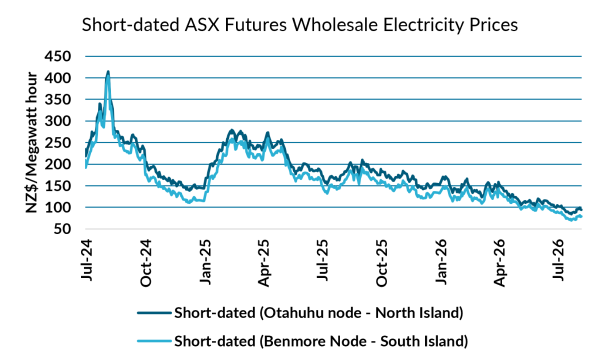
In the last decade we have also seen substantial investment in other generation including wind, solar and battery storage which will influence the El Niño cycle impact on wholesale prices. Grid-scale batteries are increasingly reshaping the electricity market, reducing peak wholesale prices and improving system flexibility. This change in the NZ electricity ecosystem may influence how wholesale prices react to the lift in generation volumes this time around. We have also seen in the last few months a material roll-off in wholesale futures prices, which may affect future company profitability, as shown in Figure 2.
Figure 2
Source: Electricity Authority, Forsyth Barr analysis
The mild increase in inflation (predominantly due to food and energy inflation) and the headwind for GDP growth if drought conditions become severe can influence monetary policy, the NZ dollar, and interest rates. The Reserve Bank of New Zealand often pays close attention to climate-driven inflation shocks because they can complicate monetary policy. The NZ Dollar (NZD) often weakens during severe agricultural droughts because of the associated fall in export volumes and deterioration in the Terms of Trade. However, global risk sentiment usually has a larger influence on NZD than El Niño alone. The impact on interest rates can be more nuanced, with higher inflation supporting higher interest rates, while lower economic growth supports lower interest rates. Bond markets generally focus on whichever effect dominates.
The impact on the NZ share market returns can be similarly nuanced. ENSO cycles have historically been associated with higher volatility and rotation between industry sectors and individual shares. Publicly-listed NZ exporters may benefit from the lower NZ Dollar as long as they can maintain production. The impact on electricity generators depends on the type and location of their generating capacity, as well as the financial hedging they have in place. Domestic-facing businesses may be exposed to slower demand. Weaker agricultural activity in both New Zealand and Australia has historically been a risk for bank lending to the sector, but recent strength in agriculture may reduce this risk in the current ENSO cycle. For all sectors, higher input costs eat into profit margins unless businesses have the pricing power to pass the increases on. ENSO cycles represent another test for company risk management – while NZ is entering the current cycle with reasonable hydro lake storage, this may change if the ENSO period is extended.
Better starting point but prepare for four seasons in one day
We know the current ENSO system is going to be warm, but we don’t know how long the ENSO system will last. The agricultural industry enters the current cycle in reasonable financial shape. Improvements to the electricity system may have reduced the risk of higher electricity prices relative to previous cycles. But a long ENSO system remains a risk for the economy and investment markets. El Niño is not all bad for investment markets – there are winners and losers – but risks need to be actively managed to optimise returns. Like the NZ weather where we can get four seasons in one day, investors should expect and position for an increase in volatility because of ENSO.
IMPORTANT NOTICE AND DISCLAIMER
This publication is provided for general information purposes only. The information provided is not intended to be financial advice. The information provided is given in good faith and has been prepared from sources believed to be accurate and complete as at the date of issue, but such information may be subject to change. Past performance is not indicative of future results and no representation is made regarding future performance of the Funds. No person guarantees the performance of any funds managed by Harbour Asset Management Limited.
Harbour Asset Management Limited (Harbour) is the issuer of the Harbour Investment Funds. A copy of the Product Disclosure Statement is available at https://www.harbourasset.co.nz/our-funds/investor-documents/. Harbour is also the issuer of Hunter Investment Funds (Hunter). A copy of the relevant Product Disclosure Statement is available at https://hunterinvestments.co.nz/resources/. Please find our quarterly Fund updates, which contain returns and total fees during the previous year on those Harbour and Hunter websites. Harbour also manages wholesale unit trusts. To invest as a wholesale investor, investors must fit the criteria as set out in the Financial Markets Conduct Act 2013.